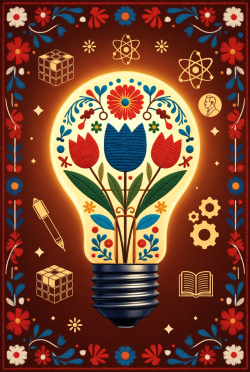
 Hungary may be small in size, but it has had an outsized influence on science and technology. Hungarian thinkers and inventors have changed the world with practical solutions and groundbreaking discoveries. You often see the same qualities: logical thinking, creativity and perseverance — traits that are also reflected in the Hungarian language.
In this article we explore important inventions and Hungary’s remarkable contribution to Nobel Prizes.
Key Hungarian Inventions
- The ballpoint pen (Biro) — László Bíró
The journalist got tired of leaky fountain pens and developed the modern ballpoint pen with quick-drying ink in the 1930s. Today it is an indispensable writing tool worldwide. - Rubik’s Cube — Ernő Rubik
Designed in 1974 as a tool to teach 3D geometry. It became a global icon that encourages logical thinking and perseverance. - Vitamin C — Albert Szent-Györgyi
He discovered the chemical structure of ascorbic acid and laid the foundation for our understanding of vitamins and nutrition. - Dynamo and electric motor — Ányos Jedlik
This Benedictine monk built prototypes in the 1820s-1830s that later became crucial for electric generators and motors. - Safety matches — János Irinyi
He invented the non-explosive match, a much safer version than previous dangerous ones. - Telephone exchange — Tivadar Puskás
He developed the concept of a central switchboard for telephone calls, essential for modern telephony. - Holography — Dennis Gabor
He laid the theoretical foundation for holography and received the Nobel Prize in Physics in 1971 for it.
Hungarians and Nobel Prizes
Hungary scores remarkably high in Nobel Prizes per capita. Some highlights:
- Albert Szent-Györgyi (1937, Physiology/Medicine) — for his work on Vitamin C.
- Dennis Gabor (1971, Physics) — for the invention and development of holography.
- Katalin Karikó (2023, Physiology/Medicine) — together with Drew Weissman for the mRNA technology that was crucial for modern vaccines.
In addition, Hungarian scientists such as John von Neumann played a key role in the development of the modern computer, although he did not receive a Nobel Prize.
What makes Hungarian inventors unique?
Many of these inventions combine abstract science with practical applications. Whether it’s a reliable pen, a cube that makes millions think, or mRNA technology that saves lives — Hungarians show that creativity and logic go hand in hand.
This inventive character is also reflected in the Hungarian language: compact, systematic and full of possibilities to form new concepts. Once you master the grammar, you can talk about this fascinating history with Hungarians yourself.
Ready to experience Hungarian logic yourself?
Whether you want to talk about inventions, science or everyday life — a solid grammar foundation makes everything easier. Master Magyar helps you step by step with cases, verbs and natural sentences.
Try Master Magyar →