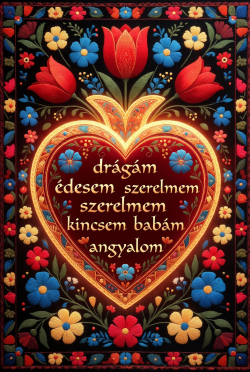
 In English we call our loved ones "honey", "darling", or "babe". In Hungary they do the same — but the words they choose are wonderfully different. Some are poetic, some are funny, and some are surprisingly down to earth. These are the terms of endearment Hungarians use for their partners, children, and closest friends.
One thing stands out immediately: Hungarian loves diminutives. By adding the suffix -ka or -ke to almost any word, you instantly create something smaller, cuter, and more affectionate. And just like in English, many Hungarian pet names are based on small animals or sweet things.
The most common terms of endearment
Literally My precious / my dear
Use The Hungarian equivalent of "darling" or "dear". Works for a partner, a child, or a close friend.
Culture Classic and timeless. Drága also means "expensive" or "precious" in the material sense — giving the word a lovely double meaning, as if saying "you are worth everything to me."
Literally My sweet one
Use Warm and widely used — close in feel to "sweetheart" in English.
Culture Édes means both "sweet" and "dear". Parents say this to children, partners say it to each other — it is one of the most universally used terms of endearment in Hungarian.
Literally My treasure / my gem
Use The direct equivalent of "treasure" in English — warm, romantic, and completely natural in everyday speech.
Culture Kincsem was also the name of Hungary's most famous unbeaten racehorse from the 19th century — a national icon. The fact that Hungarians named their greatest champion this says everything about how beloved this word is.
Literally My heart
Use "My heart" — romantic and sincere. Used for a partner or a beloved child.
Culture English speakers say "you have my heart" as a declaration of love. Hungarians skip straight to using it as a daily pet name. Szívem feels genuine, never cheesy.
Literally My soul
Use Deeper and more poetic than most pet names — closer to "my soulmate" or "my everything".
Culture In English, "soul" in a pet name sounds almost biblical. In Hungarian it is completely natural as a daily term of endearment, particularly between long-term partners.
Literally My angel
Use "My angel" — used for a partner, a child, or even a dear friend. Universal and warm.
Culture English speakers do use "angel" as a term of endearment, but it sounds slightly old-fashioned. In Hungarian it feels completely natural and is still widely used across all generations.
Animal pet names — familiar, but different
Just like English speakers call their loved ones "bunny", "lamb", or "dove", Hungarians love animal-based pet names too. The animals they choose, however, are sometimes surprising.
Literally My little bug / my little beetle
Use One of the most popular Hungarian pet names for both children and partners.
Culture Calling someone "my little bug" sounds odd in English, where insects are rarely affectionate. In Hungarian it is completely normal and very sweet. The closest English equivalent might be "little critter" — but bogaram is genuinely tender, not ironic.
Literally My little cat / my kitten
Use Playful and soft — especially used for women and girls, but also for young children.
Culture Cica is the informal word for cat (the formal word is macska). Like "kitten" in English, cicám suggests something small, soft, and delightful.
Literally My little bunny
Use Playful and cute — especially for children and young couples.
Culture English speakers also call their partners "bunny" or "honey bunny", so this one translates perfectly. The Hungarian version just stacks three suffixes to get there: nyuszi + -ka (small) + -m (my) = nyuszikám.
Literally My little bear / my teddy bear
Use For a big, soft, cuddly partner — or used playfully for someone who is warm and gentle.
Culture Mackó specifically means a teddy bear, not a wild bear (medve). Just like "teddy bear" in English suggests someone soft and huggable rather than fierce, mackóm is all warmth.
Sweet things as pet names
Hungarians love pastries and sweets — and that shows in their terms of endearment.
Literally My sugar / my little sweet
Use "My sugar" — playful, sweet, and very common in everyday speech.
Culture English speakers say "sugar" as an exclamation, but rarely as a pet name. In Hungarian, cukrom is a perfectly natural term of endearment — especially popular with children.
Literally My honey
Use The direct equivalent of the English "honey" — warm, sweet, and romantic.
Culture This is one of the few terms that maps almost perfectly from English to Hungarian. The big difference: mézem literally means "my honey" (with the possessive built in), while English "honey" is used without "my". The personal attachment is baked right into the Hungarian word.
Literally My little dove
Use Tender and poetic — heard in songs, poetry, and among older generations.
Culture English speakers sometimes call a loved one "dove", but it sounds rather literary. In Hungarian folk songs galambom is a staple. Young Hungarians may find it old-fashioned, but it never sounds wrong.
Literally My sunshine
Use Poetic and warm — someone is the sunshine in your life.
Culture English speakers will immediately recognize this one: "you are my sunshine" is a universally understood sentiment. Napfényem carries exactly the same warmth. You are more likely to find it in a love letter than in daily conversation, but it is always understood.
Playful and quirky terms
Just as English speakers call someone "dumpling", "pudding", or "muffin", Hungarians have their own wonderfully absurd pet names reserved for people they know very well.
Literally My little tummy
Use Funny and affectionate at the same time — for someone with a loveable little belly, or simply as a playful nickname.
Culture Similar in spirit to calling someone "pudgy" affectionately in English — it only works between people who are completely at ease with each other. The absurdity is the point.
Literally My little potato
Use Absurd, funny, and precisely because of that, very sweet — for someone you know completely and love unconditionally.
Culture The potato (krumpli) is the most humble, everyday staple of Hungarian folk cooking. Calling someone "my little potato" says: you are ordinary, familiar, mine — and that is exactly why I love you. English speakers call loved ones "dumpling" or "pudding" in the same spirit: not glamorous, but completely yours.
Literally Tiny one / little thing
Use Almost standard for small children — but also used playfully for a small or gentle partner.
Culture Pici simply means "tiny" or "teeny". As a pet name it carries the same warmth as "little one" in English. Simple, unadorned, and somehow perfect because of it.
The grammar of love
Perhaps the most beautiful thing about Hungarian pet names is how clearly they show the suffix system at work. Every term of endearment is built from the same three layers:
How a Hungarian pet name is built
| Base word | Diminutive (-ka/-ke) | Possessive (-m = my) | Result |
|---|
| nyuszi (rabbit) | nyuszika (little bunny) | nyuszikám | "My little bunny" |
| cica (kitten) | cicuka (little kitty) | cicukám | "My little kitty" |
| bogár (bug) | bogárka (little bug) | bogárkám | "My little bug" |
| méz (honey) | mézike (little honey) | mézikém | "My little honey" |
| szív (heart) | szívecske (little heart) | szívecském | "My little heart" |
This pattern works for almost any word in Hungarian: base word plus diminutive suffix plus possessive suffix equals a personal, loving pet name. One system, endless possibilities.
How Hungarian compares to English
What is the same, what is different?
- The same: Both English and Hungarian speakers love animal-based names (bunny, kitten, dove), sweet things (honey, sugar), and body metaphors (heart) as terms of endearment.
- Different: Hungarian always adds a possessive suffix. Szívem literally means "my heart" — the "my" is built into the word itself, not an optional addition. In English "honey" and "my honey" are both natural; in Hungarian the possessive is almost always there.
- Surprising: Insects and bugs (bogárkám) are not a standard pet name in English, but in Hungarian they are completely normal and genuinely sweet. And krumplikám (my little potato) would raise eyebrows in English — in Hungary it just means you love someone deeply and without pretense.
- Universal: In both English and Hungarian, the more absurd the pet name, the more intimate the relationship.
Want to actually use these words?
To say szívecském correctly you need to understand how diminutives and possessive suffixes work in Hungarian. It sounds complicated, but with the right explanation it is surprisingly logical. With Master Magyar you learn exactly that grammar — and before you know it, you will be calling someone bogárkám.
Try Master Magyar today